

Wearable technology has moved far beyond counting steps and estimating calories. Today, many people want a clearer picture of sleep, recovery, cardiovascular signals, stress, activity, and long-term wellness. The Hume Band 2.0 is designed around that idea. Instead of functioning like a traditional smartwatch with a screen, notifications, and apps, it takes a quieter approach: collect health-related signals continuously and present the information through the Hume Health app.
The Hume Band 2.0 is positioned as a longevity-focused wearable, with features covering heart rate, heart-rate variability (HRV), sleep, blood oxygen, skin temperature, activity, recovery, strain, and other health trends. Hume also highlights newer features such as blood-pressure trend insights, Metabolic Momentum, and Pace of Aging.
What Is Hume Band 2.0?
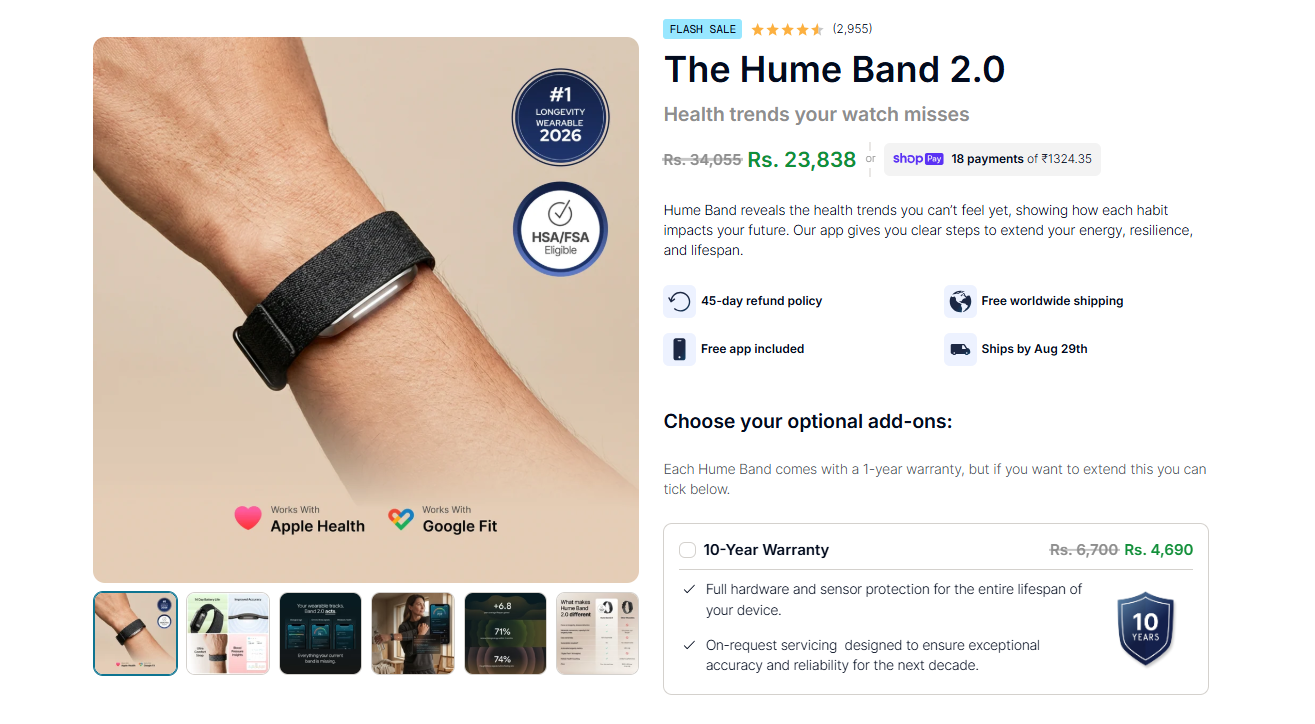
Hume Band 2.0 is a screen-free health and wellness tracker designed to be worn throughout the day and night. Rather than displaying information directly on your wrist, it sends collected data to the Hume Health smartphone app, where users can review trends, scores, reports, and recommendations.
The device is designed for people who want continuous tracking without the distraction of a smartwatch. According to Hume, the Band 2.0 uses five LEDs and four photodiodes and provides a range of health measurements and derived insights. Its listed features include continuous heart-rate monitoring, HRV, SpO₂, sleep stages, resting heart rate, skin temperature, activity, strain, recovery, and metabolic-related scores.
One of the most noticeable changes compared with the original Hume Band is battery life. Hume lists up to 14 days of battery life under typical use, with fast charging taking approximately 30 minutes for a full charge.

Design and Comfort
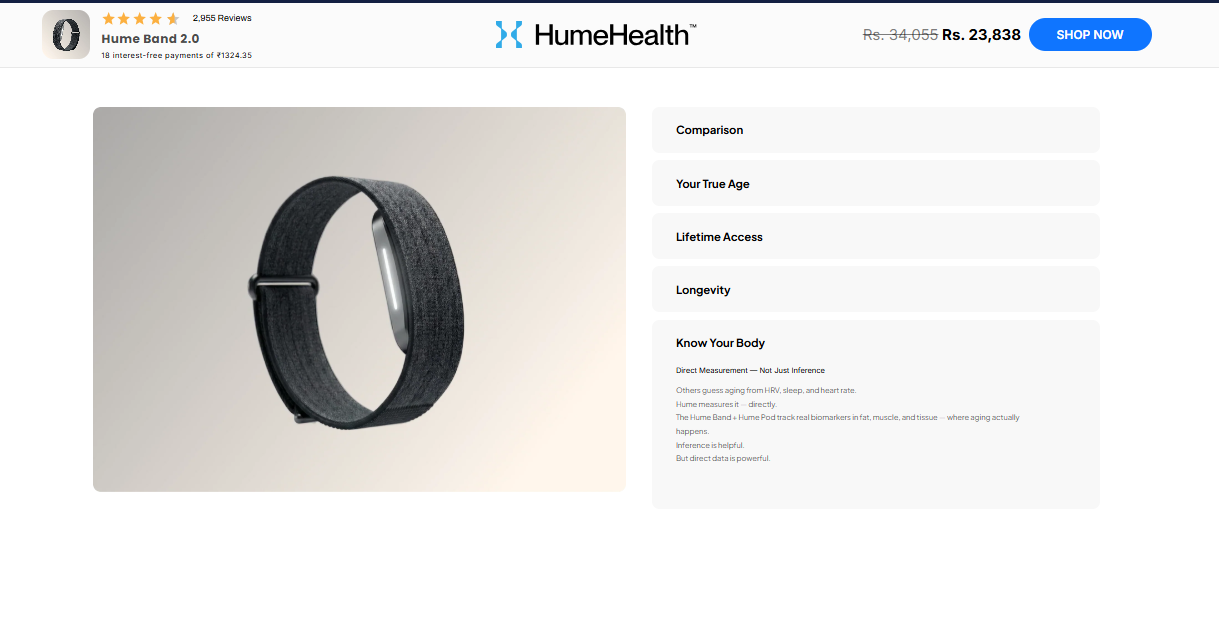
The Hume Band 2.0 follows a minimalist design philosophy. There is no screen competing for attention, which makes the device look more like a fitness band than a smartwatch.
Its UltraLux strap is designed for comfortable, extended wear. This matters because health tracking becomes more useful when the wearable can be worn consistently, particularly overnight. Independent hands-on coverage has also highlighted the updated strap and more secure hardware design as noticeable improvements over the original generation.
The Band 2.0 is also rated IP68, meaning it is designed to withstand dust and water exposure. Hume states that it can handle water up to 1 meter for as long as two hours, making it suitable for activities such as showers and swimming.
Health Metrics and Tracking
The main attraction of the Hume Band 2.0 is the number of health signals it brings together.
Heart Rate
Continuous heart-rate monitoring provides a picture of how your cardiovascular system responds throughout the day and night. Rather than relying on occasional measurements, the Band can collect data during rest, activity, sleep, and recovery.
Heart Rate Variability
HRV is another important metric for people interested in recovery and stress management. Changes in HRV can provide useful context when considered alongside sleep, resting heart rate, exercise, and lifestyle habits.
The Hume app combines these measurements to create broader recovery and wellness insights rather than asking users to interpret every number independently.
Sleep Tracking
Sleep is one of the major areas covered by the Hume Band 2.0. The device tracks sleep stages and provides information about overnight heart rate, HRV, and other signals. Hume describes the system as going beyond simply measuring how long you were in bed.
This can help users identify patterns. For example, someone might notice that late nights, inconsistent schedules, alcohol, stressful days, or intense exercise correspond with changes in their overnight recovery metrics.
Blood Oxygen
The Band also tracks SpO₂, or blood oxygen saturation. This is another data point that can contribute to an overall picture of overnight and daily wellness. However, users should understand that consumer wearables are not substitutes for clinical testing when medical concerns exist.
Skin Temperature
Overnight skin-temperature tracking can provide another baseline signal. Changes can be considered alongside sleep, recovery, activity, and other measurements to help users recognize changes in their usual patterns.
Blood-Pressure Trend Insights
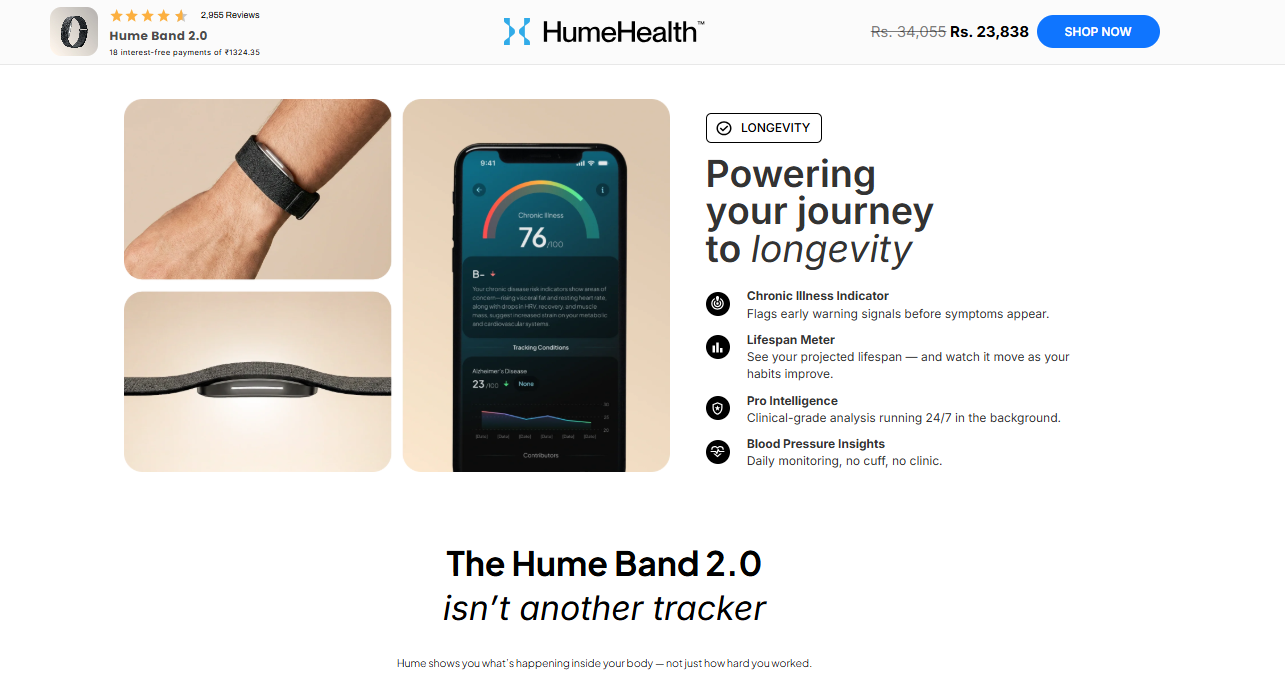
One of the headline additions in Hume Band 2.0 is blood-pressure-related trend tracking.
Hume emphasizes that this feature is intended to show patterns and directional changes over time, rather than provide a traditional blood-pressure cuff measurement. The company specifically states that the Band’s blood-pressure feature is not a replacement for a cuff and should not be interpreted as a diagnosis.
That distinction is important. A wearable trend can potentially encourage someone to pay closer attention to changes, but people should use an appropriate medical blood-pressure monitor and speak with a healthcare professional when accurate readings are required.
Metabolic Momentum and Pace of Aging
Hume’s approach differs from many conventional fitness trackers because it places significant emphasis on long-term health and longevity.
Two concepts prominently featured in the Band 2.0 experience are Metabolic Momentum and Pace of Aging. These are designed to help users understand whether their lifestyle patterns are moving their health trajectory in a favorable or unfavorable direction.
The concept is straightforward: instead of focusing only on yesterday’s step count, the app attempts to show how repeated habits affect longer-term trends.
For someone trying to improve sleep, activity, recovery, or other lifestyle factors, this type of trend-based feedback can be more meaningful than isolated daily numbers.
The Hume Health App
The Band itself is only one part of the system. Most of the interpretation happens inside the Hume Health app.
The app brings different signals into a centralized dashboard. Users can review health scores, sleep information, recovery data, trends, and other measurements. Hume also offers optional premium features that provide AI-driven insights, personalized coaching, and deeper analysis.
Importantly, Hume says a subscription is not required to use the Band or access raw health data. Premium features are optional and currently start at $8.99 per month according to the company’s product page.
That makes the ownership model different from some competing wearables that require a recurring membership for core insights.
Battery Life
Battery life is one of the strongest practical features of the Hume Band 2.0.
Hume advertises up to 14 days of typical-use battery life. Actual battery performance can vary depending on syncing, continuous tracking, and individual usage patterns. The company also says the device can reach a full charge in approximately 30 minutes.
Long battery life is particularly useful for sleep tracking. A wearable that needs to be removed every few days creates gaps in the data, while a longer-lasting device can make continuous monitoring easier.
Price and Value
At the time of writing, Hume’s US website lists the Hume Band 2.0 at $249, discounted from a displayed $356 price. The company also advertises a 45-day at-home trial and free worldwide shipping. Pricing and promotions can change, so buyers should check the current official listing before purchasing.
The company promotes the Band as a one-time hardware purchase without requiring a subscription for its core functionality and raw data. Optional premium services are available for users who want additional AI-powered analysis and coaching.
For someone comparing long-term wearable costs, this is an important consideration. A lower initial price is not necessarily cheaper if a competing device requires a monthly membership for essential features.
Hume Band 2.0 vs. Traditional Smartwatches
The Hume Band 2.0 is not really trying to replace a smartwatch.
A smartwatch is usually designed for communication, notifications, apps, music controls, navigation, workouts, and other everyday digital functions. Hume takes a different approach.
There is no wrist display demanding attention. Instead, the device focuses on collecting health information while the phone app handles analysis.
This can appeal to people who want health tracking without constantly checking notifications.
Potential Benefits
The Hume Band 2.0 may be particularly useful for people who want to:
- Monitor sleep and overnight recovery.
- Follow HRV and resting-heart-rate trends.
- Track activity and strain.
- Review SpO₂ and skin-temperature data.
- Understand longer-term wellness trends.
- Explore metabolic and longevity-focused insights.
- Track blood-pressure-related patterns over time.
- Wear a lightweight device without a screen.
- Avoid a mandatory subscription for core Band functionality.
- Build more consistent health and lifestyle habits.
The biggest advantage is arguably the combination of multiple signals in one ecosystem. Instead of looking at sleep, activity, recovery, and cardiovascular information separately, the Hume app attempts to connect them.
Potential Limitations
No wearable should be treated as a complete picture of health.
First, the Hume Band 2.0 is a wellness wearable, not a medical diagnostic device. In particular, its blood-pressure feature is intended for trend insights rather than replacing a validated blood-pressure cuff.
Second, users who want a smartwatch experience may find the screenless design limiting. You cannot simply glance at the Band to see notifications or measurements.
Third, some of the more advanced insights depend on the Hume app ecosystem and optional premium services. While core Band functionality does not require a subscription, users interested in AI coaching and deeper analysis should consider the additional cost.
Finally, health wearables can produce useful trends but should not encourage users to become overly focused on individual readings. A single unusual number is usually less meaningful than a sustained pattern.
Who Should Consider Hume Band 2.0?
Hume Band 2.0 makes the most sense for people who are interested in long-term wellness rather than simply counting steps.
It could be a good fit for someone focused on improving sleep, recovery, exercise habits, stress management, and overall health awareness. Its long battery life and screen-free design may also appeal to people who want a wearable they can largely forget about during the day.
It may be less suitable for someone who wants a full smartwatch with GPS, apps, notifications, music controls, and an on-device display.
Final Verdict
The Hume Band 2.0 takes a distinctive approach to wearable technology. Instead of trying to become another smartwatch, it concentrates on continuous health tracking and long-term wellness insights.
Its combination of heart-rate monitoring, HRV, sleep tracking, SpO₂, skin temperature, activity, recovery, strain, blood-pressure trend insights, and longevity-focused metrics gives users a broad collection of information in one platform. Hume also emphasizes a 14-day battery, IP68 water resistance, a comfortable updated strap, and a no-mandatory-subscription model.
The most important thing to remember is that the Band should be viewed as a wellness and trend-tracking tool, not a replacement for medical equipment or professional healthcare. Its greatest value comes from identifying patterns and encouraging better everyday habits.
For people who want a discreet, screen-free wearable focused on sleep, recovery, cardiovascular trends, and long-term health, Hume Band 2.0 is an interesting option in the increasingly competitive health-tracking market. Its strongest selling point is not any single metric, but the attempt to turn many daily signals into a broader picture of how your lifestyle may be affecting your health over time.