

In recent years, artificial intelligence has become part of almost every area of digital life, from business analytics and personalized recommendations to financial modeling and entertainment. One of the more unusual applications of AI is the analysis of lottery numbers. Apollo Intelligence is presented as an AI-powered lottery prediction engine designed to analyze numerical patterns and provide users with data-driven lottery number suggestions.
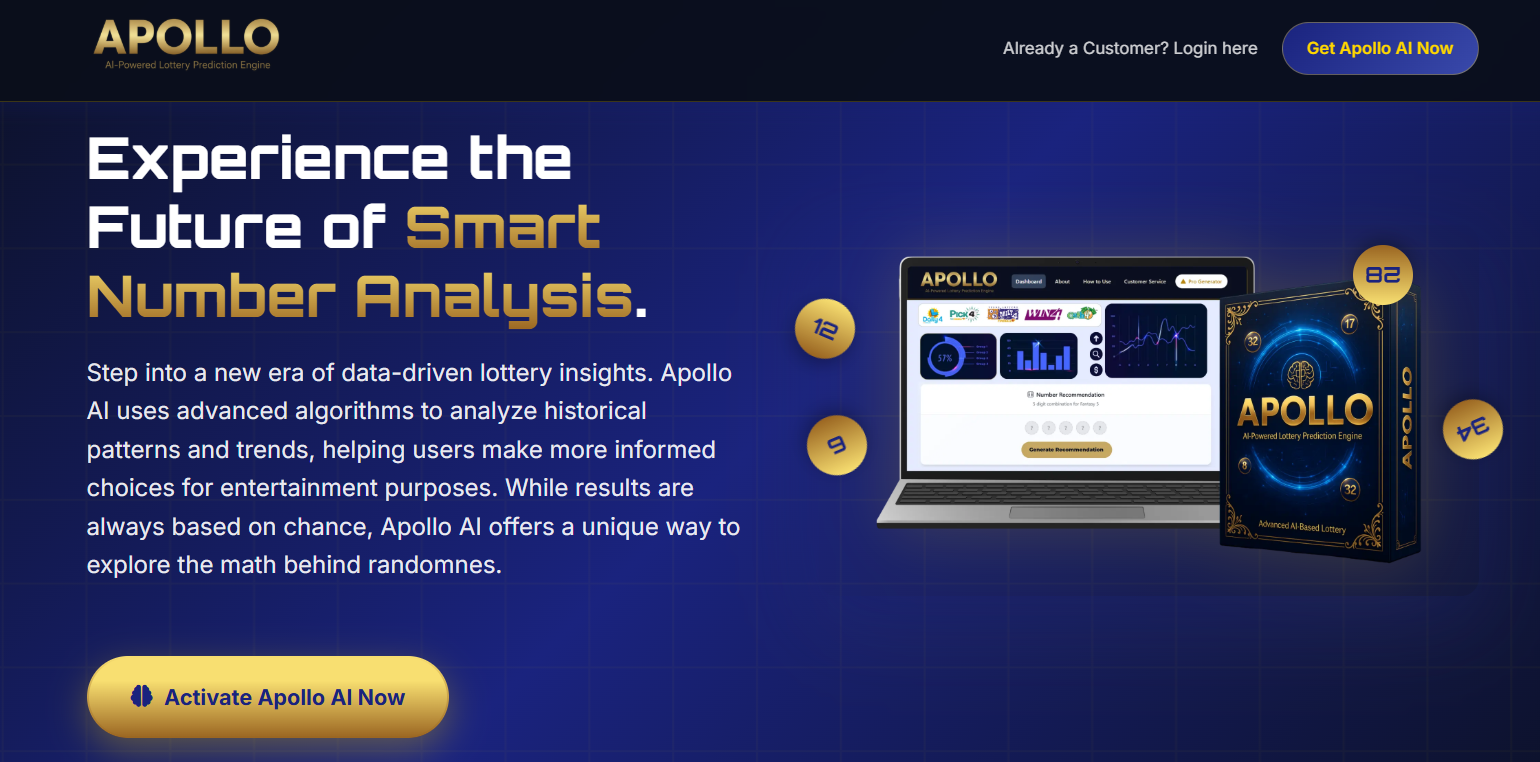
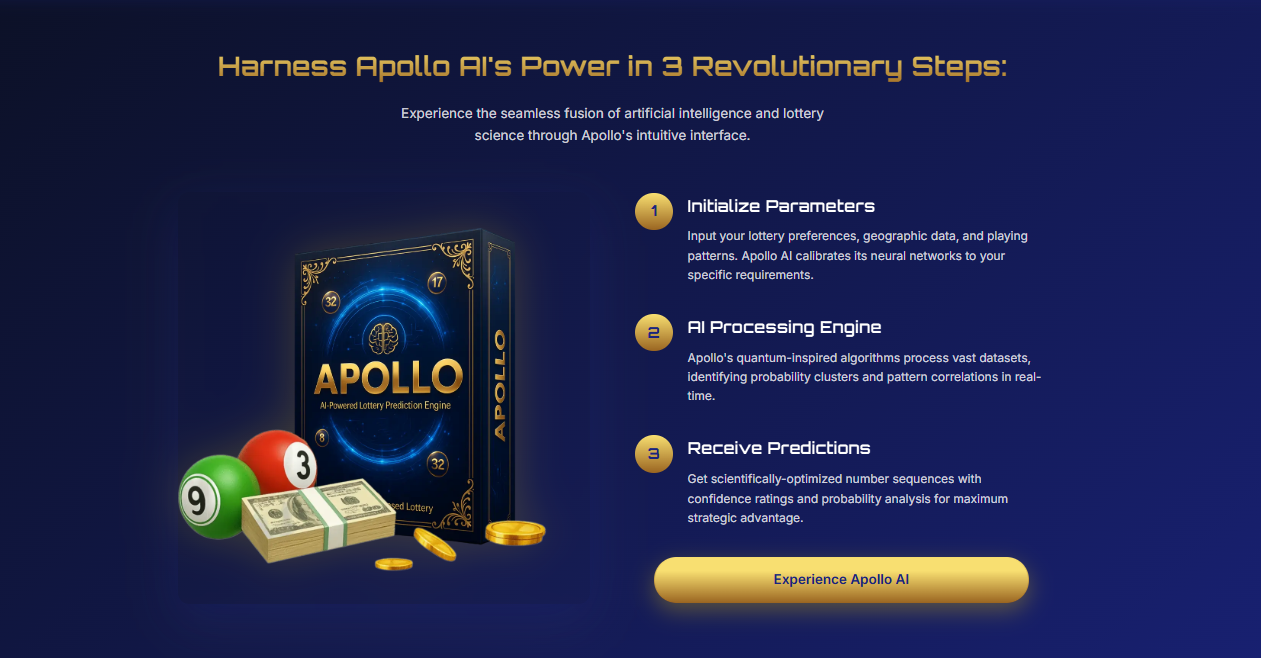
The product shown in the accompanying image combines a futuristic AI theme with traditional lottery imagery, including numbered balls, money, and a digital-style interface. Its branding suggests an emphasis on advanced computational analysis rather than simply choosing numbers at random.
What Is Apollo Intelligence?
Apollo Intelligence is presented as an AI-powered lottery prediction engine. Its central concept is to use computational analysis to examine lottery-number information and generate suggested combinations. Traditional lottery participation generally involves selecting numbers manually, using automatically generated numbers, or relying on personal strategies. An AI-based platform introduces another approach: processing historical or numerical information through algorithms and presenting the results in an accessible format.
The idea can sound highly sophisticated, particularly when artificial intelligence is involved. However, it is important to understand the distinction between number analysis and genuine prediction. In a properly conducted random lottery, previous results do not determine future results. An AI system can analyze historical information, identify statistical characteristics, and generate combinations according to predefined rules, but it cannot guarantee that a particular number will appear in a future draw.

How Could an AI Lottery Tool Work?
An AI-powered lottery application can use several types of mathematical and statistical processing. The exact technology behind a particular product depends on its implementation, but a typical system could examine historical draw information and organize it into different categories.
For example, algorithms may evaluate:
- Frequency of individual numbers
- Recent drawing patterns
- Number distribution
- Odd and even combinations
- High and low numbers
- Number ranges
- Repeated numbers
- Historical gaps between appearances
- Combinations of numbers
- Statistical relationships within previous draws
The system can then use these observations to produce suggested number combinations.
This is where artificial intelligence can make the experience more convenient. Instead of manually reviewing hundreds or thousands of previous results, software can process large quantities of information almost instantly.
Historical Data and Pattern Analysis
One of the most obvious uses of Apollo Intelligence would be historical lottery data.
Imagine a database containing years of previous lottery draws. Looking through this information manually could be difficult and time-consuming. An analytical engine can organize the results and identify characteristics that might be interesting to users.
For instance, it could identify numbers that appeared frequently during a selected period or numbers that have not appeared for several draws.
These categories are often described informally as “hot” and “cold” numbers.
A hot number is one that has appeared relatively frequently within a selected historical dataset. A cold number is one that has appeared less frequently or has gone longer without appearing.
While these classifications can make statistical analysis more interesting, they do not establish a predictive advantage in a genuinely random lottery.
AI and Number Recommendations
The central attraction of Apollo Intelligence is likely its ability to turn numerical analysis into recommendations.
Rather than simply displaying raw statistics, a prediction engine can potentially produce combinations based on selected parameters. A user might receive several sets of numbers generated according to different analytical criteria.
For example, one combination could emphasize historically frequent numbers, while another could use a balanced distribution of odd and even numbers. A third could be generated using a mixture of historical characteristics.
This can make the process of selecting lottery numbers more structured.
It is still essential to remember that a recommendation is not a guarantee. AI can process information exceptionally well, but it cannot eliminate randomness from a properly designed lottery.
Why People Are Interested in AI Lottery Tools
The popularity of AI lottery tools can be explained by several factors.
First, people naturally look for patterns when dealing with numbers. Lottery results contain large quantities of numerical information, making them particularly suitable for statistical experimentation.
Second, AI has developed a reputation for handling complex datasets. Users may therefore be curious about what happens when machine-learning or algorithmic techniques are applied to lottery statistics.
Third, automated recommendations are convenient. Someone who does not want to study historical results can use a digital system to generate combinations based on selected criteria.
Finally, AI lottery applications can make participation feel more analytical and interactive. Instead of simply choosing numbers manually, users can explore statistics, compare combinations, and experiment with different approaches.
Apollo Intelligence and the User Experience
The visual presentation of Apollo Intelligence emphasizes technology and sophistication. The dark blue interface, golden typography, glowing circular graphics, and numerical lottery balls create a combination of traditional lottery imagery and futuristic AI branding.
The product image also prominently displays the words “AI-Powered Lottery Prediction Engine.”
This positioning communicates the basic concept immediately: the platform is intended to bring artificial intelligence into the process of selecting and analyzing lottery numbers.
For a digital product, presentation can be important because users want to understand what the software is designed to do without having to navigate complicated technical information.
A well-designed lottery analysis platform might ideally provide clear sections for historical statistics, number analysis, generated combinations, and explanations of the methodology used.
Possible Features
Depending on the specific implementation, an AI lottery platform such as Apollo Intelligence could potentially include several useful analytical features.
-
Historical Results
A historical-results database can allow users to examine previous draws and identify numerical trends.
-
Number Frequency
Frequency analysis can show how often individual numbers appeared during a selected period.
-
Combination Generation
An automated generator can create number combinations according to user-selected criteria.
-
Statistical Filters
Filters could allow users to examine odd/even ratios, number ranges, repeated numbers, and other characteristics.
Charts and graphs could make large amounts of numerical information easier to understand.
-
Automated Analysis
AI can potentially automate repetitive statistical calculations, reducing the amount of manual work required.
These features can be useful for entertainment and analysis, particularly for users who enjoy studying lottery statistics.
Can Apollo Intelligence Guarantee Winning Numbers?
This is one of the most important questions surrounding any lottery prediction product.
The answer should be approached carefully: no legitimate AI system should claim that it can guarantee future lottery results when the draw is genuinely random.
Artificial intelligence can recognize patterns in historical data, generate mathematical models, and produce number combinations. What it cannot do is reliably know the outcome of a future random event simply because it analyzed previous results.
For example, if a particular number appeared several times recently, that does not necessarily mean it is “due” to disappear. Similarly, a number that has not appeared recently is not automatically more likely to appear next.
Each lottery operates according to its own rules, and the probabilities depend on the game format.
Consequently, users should treat AI-generated numbers as suggestions rather than predictions with guaranteed accuracy.
Understanding the Role of Probability
Lottery systems are fundamentally based on probability.
Consider a hypothetical lottery in which players must select a fixed number of balls from a larger group. The number of possible combinations can become extremely large. Every valid combination may have the same probability of being selected in a fair random draw.
This is why historical patterns can be interesting without necessarily being predictive.
AI can tell you what happened previously. It can calculate frequencies and relationships within existing data. But unless there is a genuine flaw, bias, or predictable mechanism in the lottery system, historical information does not provide certainty about the next result.
This distinction is essential for maintaining realistic expectations.
Responsible Use of Lottery Technology
Lottery products involve real money for many users, so responsible participation should remain a priority.
An analytical tool should not be viewed as a way to recover losses or as a guaranteed source of income. Lottery participation should be treated as entertainment, and users should only spend money they can comfortably afford to lose.
It is also wise to establish a personal spending limit before participating. Increasing spending because an AI recommendation appears convincing can create unnecessary financial risk.
Most importantly, users should avoid believing claims that suggest a particular system can eliminate lottery risk or guarantee winnings.
Technology can improve the analysis experience, but it does not change the fundamental probability of a random draw.
Advantages of an AI-Based Approach
There are several reasons someone might find Apollo Intelligence interesting.
Convenience: Automated analysis can save time compared with manually studying historical results.
Organization: Numerical information can be presented in a structured format.
Data exploration: Users can investigate frequency, distribution, and other statistical characteristics.
Combination generation: Algorithms can quickly create multiple number sets.
Technology-driven experience: AI introduces an interactive and modern approach to traditional lottery participation.
These advantages relate primarily to usability and analysis rather than guaranteed financial outcomes.

Potential Limitations
There are also limitations that users should understand.
The biggest limitation is randomness. No amount of historical analysis can guarantee the outcome of a genuinely random lottery.
Another limitation is overfitting. An algorithm may identify patterns in historical data that appear meaningful but are simply the result of chance. If a model is designed too closely around previous results, it may appear impressive historically without providing useful information about future draws.
There is also the possibility of misunderstanding statistical language. Terms such as “hot,” “cold,” “trend,” or “high probability” can sound predictive even when they merely describe historical observations.
For this reason, transparency about methodology is particularly important for AI lottery software.
Final Thoughts on Apollo Intelligence
Apollo Intelligence represents an interesting intersection between artificial intelligence, statistical analysis, and lottery entertainment. Its concept is centered on using technology to analyze numerical information and generate lottery-number suggestions. The appeal is easy to understand. AI can process large datasets quickly, organize historical information, identify statistical characteristics, and automate number generation. For people who enjoy examining lottery statistics, such a system can provide a more structured and engaging experience than choosing numbers without any analysis.
At the same time, realistic expectations are essential. AI does not remove randomness from a legitimate lottery, and historical patterns cannot guarantee future results. Apollo Intelligence and similar tools are best approached as analytical aids or entertainment rather than guaranteed winning systems. Ultimately, the value of an AI lottery platform lies in how clearly and responsibly it presents information. Users should understand the difference between statistical analysis and prediction, review any claims carefully, and always participate within sensible financial limits.